

A company’s first office in Dubai carries more weight than its floor plan. It becomes the physical expression of the business: how it receives clients, welcomes its team and presents itself in a new market.
Braymont approaches this moment with a clear standard. A respected company should not appear newly established simply because its office is new.
Consider a professional services firm preparing to open in Dubai. The country head arrives next month, eight employees are joining soon after, and the first client meetings are already in the diary. The team needs privacy, dependable connectivity and a setting that reflects the company’s standing. It does not need senior leadership dividing its attention between market entry and office setup.
For most companies in this position, a premium serviced office is the stronger first decision. It provides a complete working environment while the team, client relationships and long-term requirements settle into place. A conventional lease offers greater control, but control is valuable only when the company knows precisely what it needs and has the local resources to manage it well.
- "A new office should never make an established company feel newly arrived."
The office behind the lease
A conventional lease can seem straightforward when judged by annual rent and square footage. In reality, the agreement secures the premises. The work required to turn those premises into a functioning office still remains.
The company may need to register the tenancy, obtain fit-out approvals, appoint consultants and contractors, finalise drawings, purchase furniture, activate utilities and arrange internet connectivity. Cleaning, security, access control, maintenance and insurance also need owners, suppliers and budgets.
For many conventional tenancies, Ejari registration is one of the first formal steps. Dubai Land Department currently lists the total registration fee as AED 177.75 through Dubai REST or its website, and AED 220 through a Real Estate Services Trustee Centre. Dubai Land Department
Fit-out requirements then depend on the building, authority and proposed work. Dubai Development Authority, for example, lists a two-working-day processing period for a complete fit-out permit application. Its published fee is AED 0.90 per square foot, with a minimum of AED 200 and a maximum of AED 10,000, plus the relevant government fees. Supporting documents may include Ejari, approved drawings, a contractor appointment, an NOC issued by the building owner and clearances issued by other authorities. Dubai Development Authority
The permit period begins once the submission is complete. Design decisions, contractor selection, revisions, procurement, construction and final approvals all require additional time. A promising office can therefore become a substantial project before a single employee has taken their seat.
Utilities and connectivity introduce another layer of coordination. Commercial DEWA activation may require tenancy documents, the premises number, connection charges and a security deposit calculated according to expected consumption. DEWA states that activation takes place within 15 working hours after the applicable fees and deposit have been paid. Dubai Electricity and Water Authority
Internet installation depends on the building, provider and technical requirements. Dedicated bandwidth, private networks, firewall configuration or additional cabling can extend the setup further.
For a business with an experienced local facilities team, these responsibilities are familiar. For a company entering Dubai, they often fall to the same senior people responsible for hiring, licensing and building client relationships.
The cost of responsibility
A meaningful comparison looks beyond the rent. Deposits, agency charges, registration, design, approvals, fit-out, furniture, utilities, connectivity, cleaning, maintenance, insurance and internal management time all belong in the calculation.
The end of the lease matters as well. Reinstatement clauses may require partitions, cabling, branded finishes and fitted furniture to be removed before the premises are returned. The office can create another project at the exact moment the company is preparing for its next move.
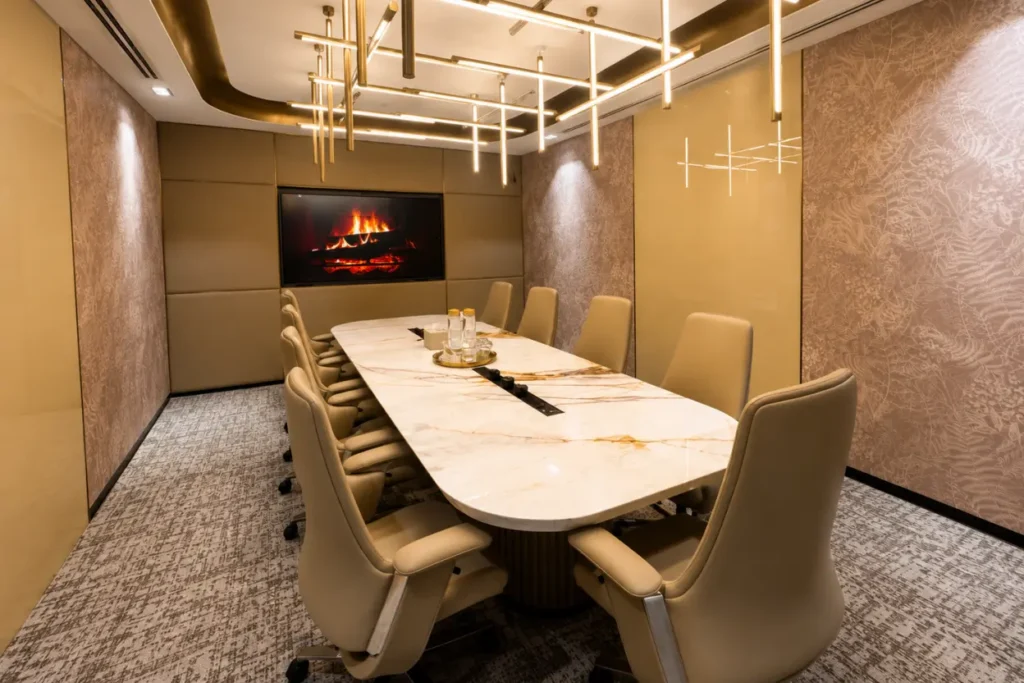
A serviced office places much of this responsibility with the operator. The space is prepared, the internet is active, meeting rooms are ready, and reception, cleaning and maintenance are already part of the working environment. The team arrives knowing the office will function. Clients are received with confidence. Everyday issues are handled without becoming management concerns.
The monthly rate may appear higher when reduced to a basic price-per-square-foot figure. Once the complete cost of setup and operation is considered, the difference often becomes far less pronounced.
- "True premium is found in the details you never need to chase."
A serviced office also gives a company time to understand how its Dubai operation will develop. An initial team of eight may become fifteen sooner than planned. Client meetings may require larger rooms or greater privacy. Certain functions may remain overseas, while others grow locally.
Beginning with an appropriately sized office allows these decisions to be made with real experience. Subject to availability, the company may later move into a larger office or take adjacent space without rebuilding its entire workplace.
A conventional lease becomes the right decision when the company has a stable headcount, an established local management structure and specialist requirements that justify complete control. A large organisation occupying most of a floor may want its own reception, dedicated workplace systems and a fully branded environment. Businesses with complex technical or security requirements may reach the same conclusion.
Until such needs are firmly established, a premium managed environment will usually serve the business better.
The Braymont standard
Braymont begins with the way the company intends to operate. Team size, move-in date, preferred location, privacy, client requirements, technology needs and likely expansion are considered before a workspace is recommended.
Suitable offices at Emaar Square or Dubai CommerCity can then be shortlisted against that brief. The proposal can clearly set out the layout, included services, meeting-room access, reception support, connectivity options, additional charges and available expansion routes.
Larger teams can discuss private cabins, customised layouts, dedicated IT and company branding before choosing their office. If specific premises documentation is required for licensing, the available documentation can be clarified early, before commitments are made.
This considered approach shapes the entire arrival. The team walks into an office prepared for the working day. Guests are welcomed into a setting that reflects the company’s standards. The practical details remain quietly managed in the background.
- "The space is ready. The welcome is assured. The standard is already in place."
For most companies entering Dubai, a serviced office should be the starting point. A conventional lease can follow when the business has the stability, scale and local experience to make full use of that control.
The first office has a more immediate role. It should give the company presence, support its people and allow the business to begin as it intends to continue.

Clear and thoughtful article. I like how you focus on impact and patterns, not just whether something feels uncomfortable. That distinction helps readers reflect without jumping to self-diagnosis.
The calm, grounded tone makes it easier to understand when something is part of normal life—and when it might be worth getting support.